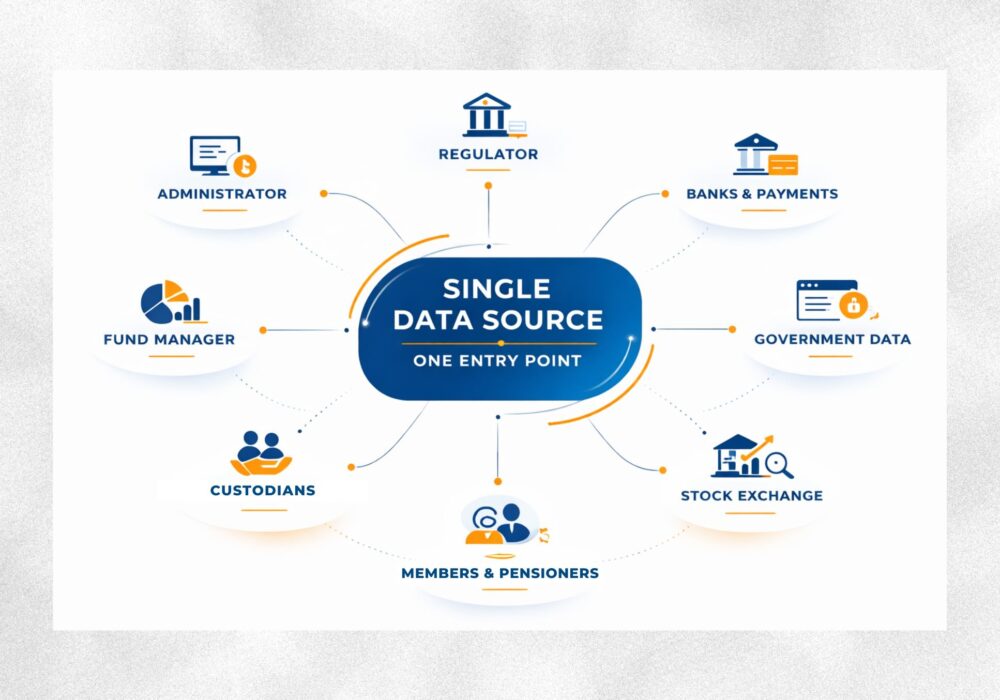

Across Africa and emerging markets, pension systems are becoming more complex. Multiple stakeholders – Sponsors (Employers), Administrators, Custodians, Fund Managers, Regulators, Banks, Government Agencies, Members, and Pensioners – all depend on the same core data to make decisions, execute transactions, and ensure compliance.
Yet in many pension environments today, the same data is entered multiple times across different institutions, systems, and processes.
This duplication is not just inefficient; it is risky.
It creates inconsistencies, reconciliation delays, fraud exposure, regulatory breaches, poor member experience, and operational costs that ultimately reduce retirement outcomes.
The future of pension administration lies in Integrated Pension Ecosystems with Strong Data Governance – built around a Single Entry Point and a Single Source of Truth.
The Pension Ecosystem: A Data Value Chain
A modern pension ecosystem is not a collection of independent institutions. It is a connected data value chain. At the center lies member and contribution data, which originates primarily from the Sponsor (Employer) and flows through:
Pension Administrator > Custodian > Fund Manager > Regulators > Banks & Payment Systems > Government Identity & Population Databases > Capital Markets & Stock Exchanges > Members & Pensioners
When integration is weak, every institution recreates its own version of reality. When integration is strong, the ecosystem operates as one coordinated financial infrastructure.
The “One Entry Point” Principle
The most powerful governance concept in pension data management is simple:
Data should be captured once – at source – and reused everywhere.
For example:
- Employer uploads payroll and contributions once.
- That same dataset automatically flows to: Administrator for member accounts Custodian for fund receipt confirmation Fund Manager for investment allocation Regulator for compliance monitoring Banks for payment reconciliation Members for real-time statements
No re-keying. No duplication. No inconsistencies.
This approach delivers:
✅ Accuracy ✅ Transparency ✅ Speed ✅ Cost efficiency ✅ Fraud reduction
Integrated Architecture: The Digital Pension Backbone
A fully integrated ecosystem requires a Digital Pension Backbone Platform with secure APIs connecting all stakeholders.
Key integrations include:
1. Sponsors (Employers)
- Payroll integration
- Contribution schedules
- Employee onboarding and exits
2. Administrators
- Member lifecycle management
- Benefits processing
- Compliance reporting
3. Custodians
- Contribution receipts confirmation
- Asset reconciliation
- Settlement confirmations
4. Fund Managers
- Portfolio positions
- Investment performance
- NAV reporting
5. Regulators
- Automated statutory reporting
- Risk dashboards
- Supervisory analytics
6. Banks & Payment Systems
- Contribution payments
- Benefit disbursements
- Reconciliation automation
7. Government Services
- National ID verification
- Death notifications
- Population registry validation
- Tax authority integration
8. Capital Markets & Exchanges
- Market prices
- Benchmark indices
- Performance comparisons
9. Members & Pensioners
- Mobile self-service portals
- Real-time balances
- Benefit projections
- Claims processing
Data Governance: The Foundation of Trust
Integration without governance creates chaos. Governance without integration creates bureaucracy. A successful pension ecosystem requires both. A strong data governance strategy should include:
Master Data Management (MDM)
One authoritative source for:
- Member identity
- Employer data
- Contributions
- Investment holdings
- Benefits
Data Ownership & Stewardship
Clear accountability:
- Who creates data?
- Who validates data?
- Who approves changes?
- Who audits data?
Data Standards & Dictionaries
Uniform definitions across institutions:
- Contribution types
- Member status codes
- Benefit categories
- Investment classifications
Data Quality Controls
Automated validation rules:
- Duplicate detection
- Contribution variance alerts
- Identity verification
- Exception workflows
Security & Privacy Framework
Protection across the ecosystem:
- Encryption in transit and at rest
- Role-based access controls
- Zero-trust architecture
- Multi-factor authentication
- Audit trails
Regulatory Compliance & Auditability
Real-time compliance monitoring:
- Automated reporting
- Traceable transactions
- Immutable logs (potentially blockchain-enabled)
Strategic Benefits for Stakeholders
For Regulators
- Real-time supervision instead of periodic reporting
- Early detection of risks
- Reduced regulatory arbitrage
For Trustees
- Better governance oversight
- Transparent fund performance
- Improved fiduciary compliance
For Administrators
- Lower operational costs
- Faster processing
- Reduced reconciliation workload
For Fund Managers
- Accurate allocation data
- Faster investment decisions
- Better performance analytics
For Employers
- Simplified compliance
- Reduced administrative burden
- Payroll integration efficiency
For Members and Pensioners
- Convenience and transparency
- Faster benefit payments
- Trust in the system
The African Opportunity
Many developed markets are constrained by legacy systems.
Africa has a unique opportunity to leapfrog directly into digitally integrated pension ecosystems built on:
- Cloud-native platforms
- API-driven architecture
- Mobile-first member engagement
- National digital identity systems
- Real-time payments infrastructure
- AI-driven analytics
This transformation can dramatically improve retirement outcomes across the continent.
The Role of AI and Advanced Analytics
Once data integration is achieved, the real value emerges.
AI can enable:
- Contribution compliance prediction
- Fraud detection
- Investment optimization
- Longevity risk modelling
- Personalized retirement planning
- Regulatory risk alerts
- Member behavior insights
Integration is the foundation. Intelligence is the multiplier.
The Strategic Imperative
The pension industry is moving toward ecosystems, not institutions.
The winners will be those who:
- Integrate early
- Govern data effectively
- Collaborate across stakeholders
- Build trust through transparency
The question is no longer whether integration will happen.
The question is: Who will lead the ecosystem transformation – and who will be forced to follow?
If you are involved in pensions, regulation, or financial services transformation, I would value your thoughts:
What do you think is the biggest barrier to achieving a fully integrated pension ecosystem?
#Pensions #DataGovernance #DigitalTransformation #FinTech#BuiltInAfricaForAfrica #Leadership