After more than two decades working in pension administration across Africa, one fundamental question keeps keeping me up at night:
How many pension professionals truly understand both sides of the balance sheet; the assets and the liabilities?
The answers I’ve encountered over the years are revealing.
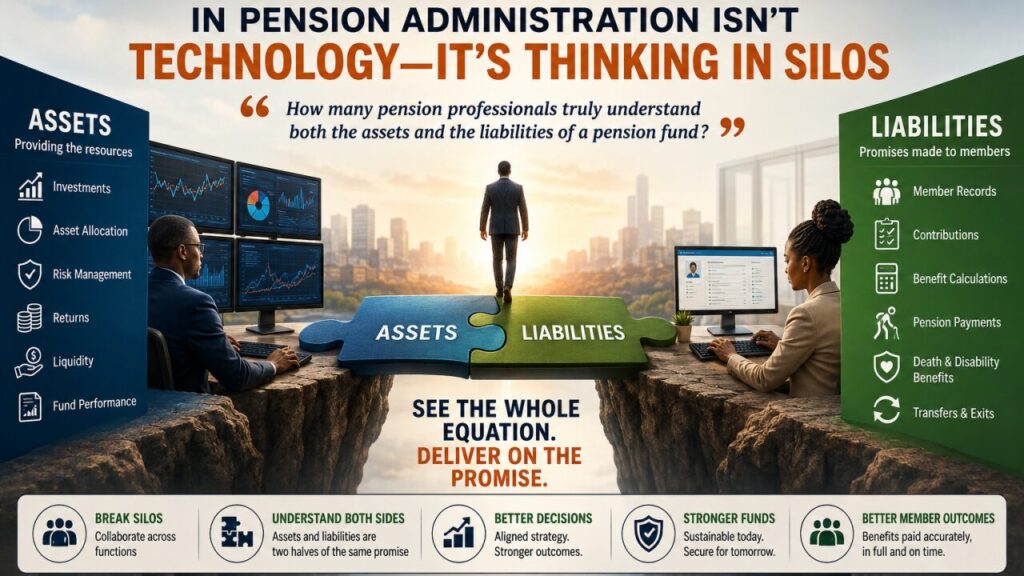
Throughout our industry, we have built incredible walls of specialization. On one side, you have brilliant professionals who spend their entire careers becoming exceptional at member benefit administration. They live and breathe contributions, member records, complex benefit calculations, pension payroll, transfers, and regulatory compliance. On the other side, you have highly accomplished investment minds focused on fund accounting, market portfolios, and financial reporting.
Both groups are undisputed masters of their respective domains. Yet, surprisingly few appreciate how these two worlds continuously shape, pull, and influence one another. In my view, this disconnect is one of the greatest hidden risks facing pension funds today.
The Core Truth: Assets Exist to Meet Liabilities
At its absolute heart, every pension fund is built around one deceptively simple principle: Assets exist solely to meet liabilities.
Everything else: the cutting-edge technology, corporate governance, administration workflows, investment strategies, actuarial valuations, and legal compliance; exists purely to support that single relationship. The liabilities represent the sacred promises made to members; the assets represent the real-world resources accumulated to honor them. One has zero purpose without the other.
Unfortunately, many organizations unintentionally run these two disciplines like separate companies. The administration team focuses entirely on members. The investment team focuses entirely on markets. Finance manages the ledger, actuaries crunch the historical valuations, and trustees receive independent reports from each silo.
Every department performs beautifully within its own mandate, yet almost no one is looking at the complete, interconnected picture.
The Invisible Ripple Effect of Day-to-Day Administration
What many administrators don’t realize is that they are actively shaping the long-term liabilities of the pension fund every single day.
Administration is far more than just processing routine data entries. Every time a new member is registered, a contribution is posted, a salary is updated, a service period is corrected, or a benefit is calculated, you are changing the future financial obligations of the fund.
- A seemingly minor salary adjustment today can compound into increased pension payouts for decades.
- A single missed contribution stalls investment earnings over many years.
- A benefit calculation error creates ongoing financial leaks that persist throughout a member’s retirement.
When you look at it through this lens, routine administration is actually the continuous architectural design of the pension fund’s liability profile.
Shifting the Investment Conversation
On the other side of the equation, investment professionals aren’t simply managing portfolios to beat market benchmarks. Their real, human responsibility is to ensure that when a member reaches retirement, the cash is actually there.
That requires balancing growth with absolute liquidity, forecasting shifting cash flows, protecting against inflation, and constructing portfolios that remain sustainable over generations.
The ultimate test of an investment portfolio isn’t whether it outperformed a market index this quarter. The real question is: Will this portfolio enable the fund to honor every single promise made to its members?
That shift in perspective changes the conversation entirely. An investment portfolio delivering exceptional returns but lacking the liquid cash to pay out pensions when they fall due isn’t a success; it’s a structural failure. Conversely, a highly liquid portfolio that fails to generate adequate long-term growth beats inflation but starves the members it was established to protect. True success lives in the balance.
When Silos Cost Money: A Tale of Two Departments
When these two halves of the same coin operate in isolation, real friction occurs.
Imagine an administration department that spots an unusually large wave of member retirements hitting over the next six months. If this operational insight isn’t communicated to the investment team early, the consequences are costly. The investment team might be forced to liquidate assets unexpectedly during an unfavorable market downturn just to cover the payroll. It’s an entirely avoidable financial hit.
Now consider the reverse. An investment committee approves significant allocations into long-term, illiquid assets because the projected returns look spectacular. Months later, pension payroll demands spike much faster than historical data predicted. Suddenly, the fund needs immediate liquidity. Assets must be sold off early at a loss, creating unnecessary costs.
In both scenarios, neither department made a poor decision. They simply made decisions in the dark, without seeing the whole picture.
Why Technology Alone Won’t Save Us
As pension funds across Africa aggressively invest in digital transformation, there is a widespread belief that technology alone will dissolve these boundaries. We are implementing modern administration systems, automated investment platforms, artificial intelligence, and sophisticated business intelligence tools.
These are incredibly valuable developments. But let’s be clear: technology cannot integrate minds that are committed to thinking in silos.
The future doesn’t just belong to integrated platforms; it belongs to integrated professionals.
Imagine looking at a leadership dashboard that goes beyond reporting a standard 11.4% monthly investment return. Imagine instead being able to confidently answer the far more meaningful question: “How has this month’s investment performance directly improved our funding ratio to meet our future pension obligations?”
That is the level of insight pension leaders should be demanding.
The Rise of “Asset–Liability Thinking”
To get there, our industry needs a new generation of pension professionals—individuals who deliberately look past the borders of their own specialization.
- If you work in administration: Spend time with your investment managers. Learn about portfolio construction, liquidity management, asset allocation, and fund accounting.
- If you work in investments: Sit down with the benefit administrators. Understand contribution processing, data quality challenges, pension payroll, and how a tiny administrative adjustment ultimately transforms into an actuarial liability.
Something remarkable happens when teams cross-train this way. Departments stop optimizing for their own internal metrics and start optimizing for the pension fund as a whole.
Our approach to professional development must evolve. We have excellent specialized training programs for actuarial science, governance, and technology. But we need to introduce a cross-cutting discipline: Asset–Liability Thinking. Not just as a highly technical mathematical exercise for actuaries, but as a core mindset for every single professional in the building.
Because every contribution received eventually becomes an investment. Every investment ultimately becomes a benefit payment. And every benefit paid fulfills a lifetime promise. Everything is connected.
Conclusion: Two Halves of the Same Promise
It is time for pension funds, regulators, training institutions, and technology providers to intentionally bridge this knowledge gap.
We can accelerate this shift by embedding cross-functional training into our organizations, demanding that software providers integrate member workflows with actuarial and investment modeling, and evolving trustee reporting away from disconnected operational PDFs toward unified impact metrics.
The pension leader of the future must be just as comfortable discussing the nuances of benefit calculations as they are debating duration, liquidity risk, funding ratios, and strategic asset allocation.
Ultimately, members do not trust us with their hard-earned money because they want to admire our administration systems or marvel at our investment yields. They contribute because they expect one simple, human outcome: that when retirement day comes, their benefits will be paid accurately, in full, and on time.
Everything else we do is simply the machinery behind that promise.
The next evolution of our industry isn’t about producing better isolated specialists. It’s about cultivating professionals who realize that assets and liabilities are simply two halves of the exact same promise. When those two halves move in perfect alignment, governance tightens, decisions sharpen, and most importantly member outcomes dramatically improve.