
What, Exactly, Are We Preparing People to Retire Into?
Imagine two people retiring with exactly the same monthly pension.
One owns a modest home, has planned for healthcare, carries little debt and has meaningful relationships beyond the workplace. She knows how she wants to spend her time and where her experience is still needed.
The other pays rent, supports dependants, carries outstanding loans and is uncertain about medical cover. His closest relationships were built around his job. When the employment ends, so does much of the structure that gave his days meaning.
Their pension statements may suggest similar retirement outcomes.
Their lives will tell different stories.
That difference brings us to a question the pension industry must confront:
When we describe a retirement benefit as “adequate”, adequate for what?
In Conversation 3, I argued that our industry must move beyond assets under management to measure what happens to the member. But changing the scoreboard requires clarity about the outcome we want.
We cannot meaningfully measure retirement success until we agree on what a successful retirement should make possible.
The Limits of Replacing a Salary
The replacement ratio compares retirement income with earnings before retirement. It helps us assess the extent to which a pension might sustain a person’s previous standard of living.
It is a useful measure. We should continue using it.
But a percentage of previous earnings cannot, by itself, tell us whether someone will live securely or with dignity.
For a low-paid worker, replacing a substantial proportion of earnings may still leave too little for essential needs. If working life was financially precarious, reproducing that income in retirement may simply reproduce the hardship.
Conversely, someone whose mortgage is settled, whose dependants are financially independent and whose essential costs are manageable may need a different proportion of previous earnings to sustain a satisfactory life.
Even the denominator deserves scrutiny. Are we comparing the pension with final salary, average earnings or take-home pay? Did employment include housing, medical cover or transport that must now be funded personally?
For an informal worker with fluctuating earnings, there may be no stable final salary to replace.
A replacement ratio tells us something about continuity of income. It does not tell us enough about the sufficiency of that income – or the quality of the life it must support.
Start with the Life the Income Must Sustain
A better adequacy conversation begins with the household.
Where will this person live? What will food, utilities, transport and healthcare cost? Who depends on them? Which debts will remain? What happens if a spouse dies or a family member needs care?
These questions bring retirement planning closer to the circumstances in which benefits will actually be spent.
Africa is not one retirement market. Household structures, public services, housing costs and social protection arrangements differ across countries and communities. An adequacy framework must accommodate those differences.
It must also make room for the distinction between a desired lifestyle and a minimum acceptable standard of living. A pension may fall short of someone’s aspirations while still meeting essential needs. Another may replace a respectable share of earnings while failing to meet those needs.
Both situations deserve honest communication. They require different responses.
We should therefore assess income against the member’s likely expenditure and circumstances, alongside the replacement ratio. Otherwise, we risk offering reassurance through a percentage that has never been tested against a household budget.
Financial Adequacy Must Endure
An adequate income on the first day of retirement is only a starting point.
It must remain useful over time.
I propose that we assess financial adequacy through four connected tests: sufficient income, lifetime sustainability, preserved purchasing power and reliable access.
Sufficiency asks whether income can meet reasonable needs.
Sustainability asks how that income will continue throughout retirement, including if the person lives longer than expected.
Purchasing power asks what rising prices will do to the goods and services the pension can buy.
Reliable access asks whether money reaches the retiree accurately and predictably, through channels they can actually use.
A benefit can pass one test and fail another. A large lump sum may look sufficient but lack a credible plan for sustained income. A regular pension may arrive reliably while its purchasing power steadily declines. A correctly calculated benefit may offer little immediate security if payment is delayed.
These are different weaknesses, and they should be visible separately.
A single reassuring figure should never conceal the point at which a retirement plan is vulnerable.
Housing and Health Change the Meaning of a Pension
Consider housing.
Two retirees receiving the same income face very different pressures if one has secure accommodation and the other must meet rent from every payment.
Yet home ownership is not a complete answer either. A home requires maintenance, utilities and sometimes adaptations as its occupants age. Its location affects access to family, transport and care. A valuable property does not automatically provide money for daily expenses.
The question is whether the retiree has secure, suitable housing that they can afford to sustain.
Healthcare requires equally deliberate attention. Retirement planning should establish what cover continues after employment, what it excludes and what costs the household may need to meet directly.
We will examine this more deeply in Conversation 5. For now, the principle is straightforward: an income projection that overlooks foreseeable health expenditure offers an incomplete picture of adequacy.
Food, shelter and care are not peripheral to the pension calculation. They are among the reasons the calculation matters.
The Family Must Be Part of the Conversation
Retirement planning sometimes assumes that financial responsibility ends when employment does.
For some households, it does not.
A person may reach retirement while supporting children, grandchildren, a spouse, elderly relatives or other dependants. Family support can also flow in the opposite direction, providing companionship, practical assistance and income.
Those relationships matter. They should be understood without being romanticised.
Relatives’ willingness to help does not guarantee their financial capacity to do so. Equally, planning that treats every retiree as an isolated individual may overlook obligations that strongly influence how benefits will be used.
A useful retirement conversation asks which commitments will continue, what support is dependable and what boundaries the household needs to discuss.
This is also where legacy becomes practical. Keeping beneficiary information current, organising important records and discussing wishes can reduce avoidable confusion for those left behind.
Legacy includes what a person passes on through guidance, relationships and service. It should not become another financial expectation imposed on someone already struggling to meet essential needs.
A Funded Retirement Can Still Feel Empty
There is another dimension our industry cannot calculate through a replacement ratio.
Employment can provide identity, daily structure, friendships, recognition and a sense of usefulness. Leaving it may change all of these at once.
A person can receive their pension on time and still struggle with the question:
Who am I now that I no longer hold that position?
That question sits at the heart of my book, From Retirement to Preferment.
Preparing for retirement includes helping people imagine where their experience, wisdom and interests might find expression beyond formal employment. That could mean mentoring, community service, family life, learning, creative work, enterprise or simply a more deliberate rhythm of living.
It must also include permission to rest. A dignified retirement does not require everyone to establish a business or prove their worth through continued productivity.
The point is agency: the ability to make meaningful choices about one’s later years.
A pension can help finance those choices. Preparation helps a person recognise and exercise them.
A Broader Definition with Clear Responsibilities
I propose that we understand retirement adequacy as:
The capacity to sustain a dignified life throughout retirement, supported by sufficient and dependable financial resources, secure living conditions, access to healthcare, meaningful relationships and the freedom to live with purpose.
This is a proposed framework for thinking about outcomes, not a claim that pension funds can guarantee every part of life.
Trustees cannot guarantee happiness. Administrators cannot repair family relationships. Pension assets should not be diverted into activities outside a scheme’s lawful mandate.
Clear boundaries are essential.
But recognising those boundaries should help institutions decide what they can influence. Funds can improve projections, explain benefits clearly, identify administrative obstacles and help members understand their options. Employers can support preparation before the final months of service. Appropriate partners can provide specialist guidance.
Public authorities have a role in the wider conditions affecting older people, including healthcare, social protection and accessible services.
The broader outcome requires coordination, with each institution accountable for its own contribution.
What Should Change in Practice?
The first change is the member conversation.
Alongside the benefit balance, members should receive understandable illustrations of likely retirement income, with assumptions and uncertainty clearly explained. Those illustrations should help them consider essential expenditure, inflation and household commitments.
For members with irregular earnings, the conversation must accommodate contribution patterns that differ from continuous salaried employment.
The second change is timing.
Preparation needs to begin while members still have room to respond. A seminar shortly before retirement cannot recover decades of missed contributions or resolve every longstanding commitment. Earlier engagement creates more opportunities to adjust expectations and make workable decisions.
The third change is how trustees review readiness.
Boards should seek evidence about projected income shortfalls, member understanding, unresolved records and the practical barriers to receiving benefits. Voluntary information about broader preparedness can help shape education and support, provided privacy is respected.
MOCA contributes to this agenda by examining whether the institution delivers accurate, timely, understandable, accessible and fair member outcomes. Broader retirement readiness also requires information beyond administrative performance.
We should keep those measures distinct enough to show where a problem lies – and connected enough to prompt action.
Collecting more data is useful only if someone takes responsibility for responding to what it reveals.
The Life After the Final Payslip
The pension industry accompanies people through years of contribution and accumulation.
Our work eventually meets its most important test in the life that follows.
Can the retiree meet essential expenses without constant anxiety? Can they access care? Is their housing secure? Do they understand their income and its limitations? Can they remain connected to others and make choices about how they spend their time?
No single percentage can answer all of those questions.
That does not make the questions less worthy of attention. It makes our responsibility to ask them more urgent.
At the next discussion of retirement adequacy, let us put the replacement ratio beside the household budget, the healthcare arrangements and the member’s plans for life after employment.
Then let us ask:
What kind of life will this benefit actually make possible – and what can we do, within our responsibility, to improve it?
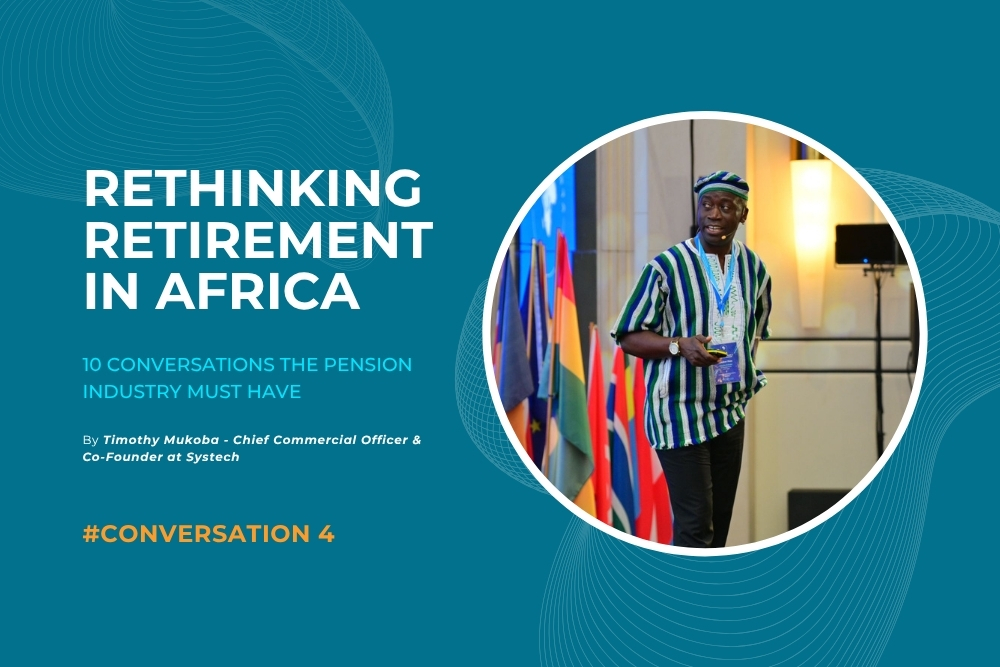
This is Conversation 4 of my series, Rethinking Retirement in Africa: 10 Conversations the Pension Industry Must Have.
Next: Conversation 5 – The Retirement Healthcare Time Bomb Africa Is Not Talking About Enough on 12th October 2026.
Related Article: Conversation 1: Africa Doesn’t Have a Pension Problem – It Has a Retirement Outcomes Problem